Run your soccer club
from one app.
Youth soccer runs long seasons with large squads, and the admin load is mostly repetition: the same questions about the same events, the same twenty families, every week from August to November.
Soccer scheduling that
survives a rained-off Saturday.
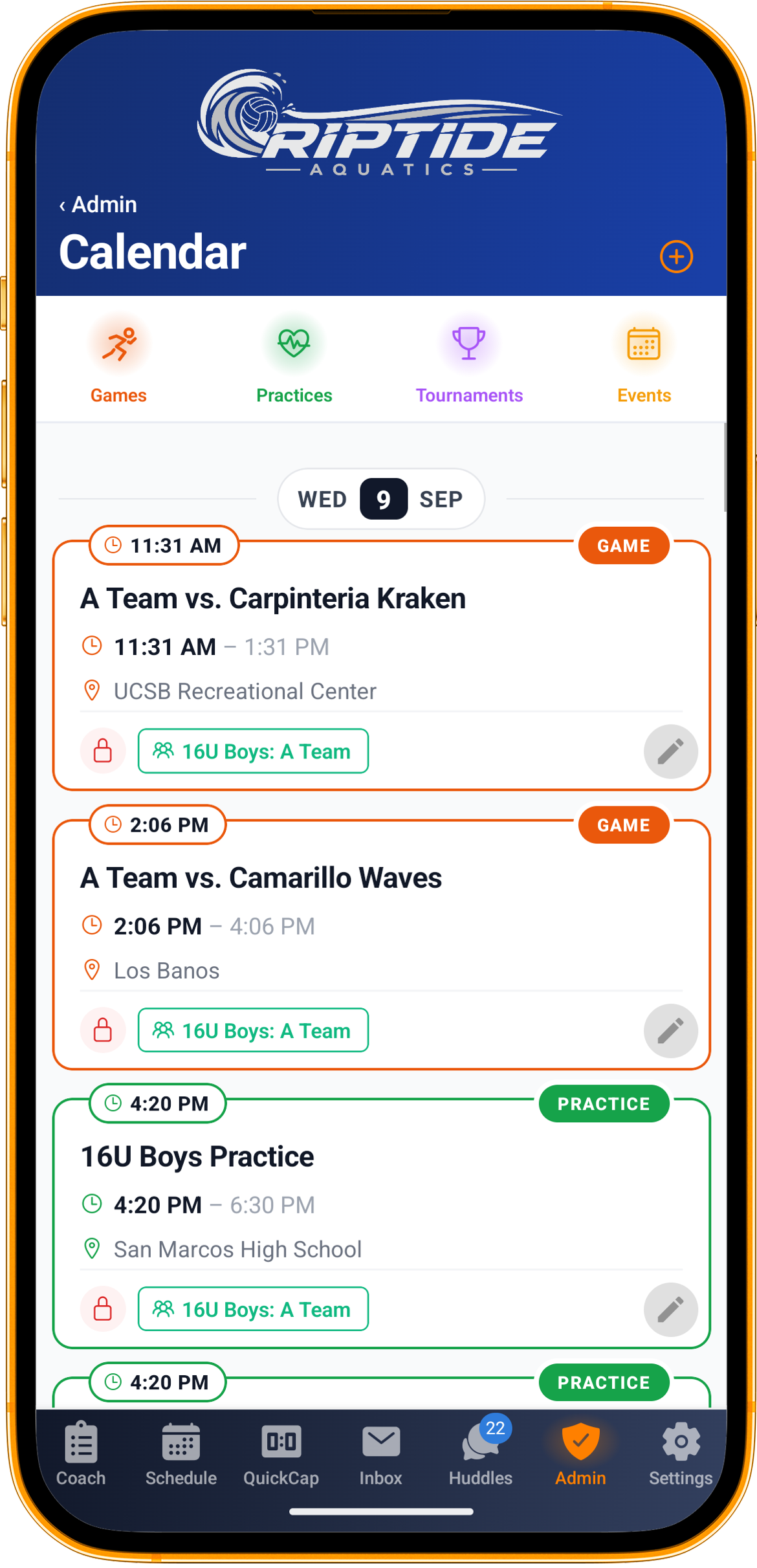
Publish the season once and let every family subscribe to it. When a match moves, the calendar they already have moves with it.
One schedule, attached to the teams it concerns
Rostered holds one schedule for the club and attaches every match and practice to the teams it applies to. Families subscribe once in Google, Apple or Outlook and that feed keeps updating, so a rescheduled kickoff arrives in the calendar a parent already looks at instead of sitting in a PDF from preseason that three people have since edited.
What the calendar entry actually tells you
The calendar entry carries what a Saturday morning actually needs: the complex, the specific field within it, the address, whatever the club wrote about parking and gate access, and the forecast for that location on that date. On a wet Friday night the real question is whether the field will hold, and it gets answered on the event rather than in a group thread at ten o’clock.
Move a match, send one message
When a match does move, the club sends one notification for that event rather than one per edit, so a coach who fixes the kickoff time and then the field number has not pinged fifty families twice in four minutes. Families who want less noise can mute a single event or an entire recurring training slot without leaving the club’s schedule.
Know your eleven
before Saturday.
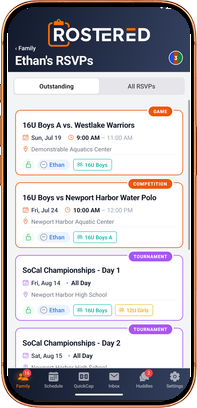
Per-athlete RSVPs with reminders that link straight to the match, then present and absent marking at practice.
Every player asked, not the group
Every athlete on the match is asked individually, and families answer in the app or on the web. Rostered tracks whether the invitation was sent, viewed or answered, so a parent who opened it and did not reply gets a different nudge from one whose email never arrived. Reminders chase only the families still outstanding, and they link straight to the match rather than dropping someone on a homepage.
The coach sees a number, and the names behind it
The coach sees a live count of confirmed, declined and pending with the names behind each number, which is the list a lineup actually gets built from. Tournament weekends are answered per day, so a family available Saturday but away at a cousin’s wedding on Sunday gives exactly that answer instead of writing a paragraph a coach has to interpret.
Attendance on the sideline
At practice, attendance is marked present or absent from a phone on the sideline. An absence can be excused with a reason, illness, injury, school or family, and a guardian’s own check-in is recorded separately from the coach’s mark rather than overwriting it. Over a long fall season that is the difference between a record worth reviewing and a spreadsheet of guesses.
Soccer rosters that
follow the player.
Goalkeepers, defenders, midfielders and forwards, with jersey numbers and guardian contacts, on the coach’s phone at the field.
Goalkeeper, defender, midfielder, forward
Rostered models soccer positions the way the sport does: goalkeeper, defender, midfielder and forward, alongside jersey numbers and the guardian contacts a coach actually needs two minutes before kickoff, when a player has gone down and nobody can remember which parent drove.
Under-7s to under-19s, without one long list
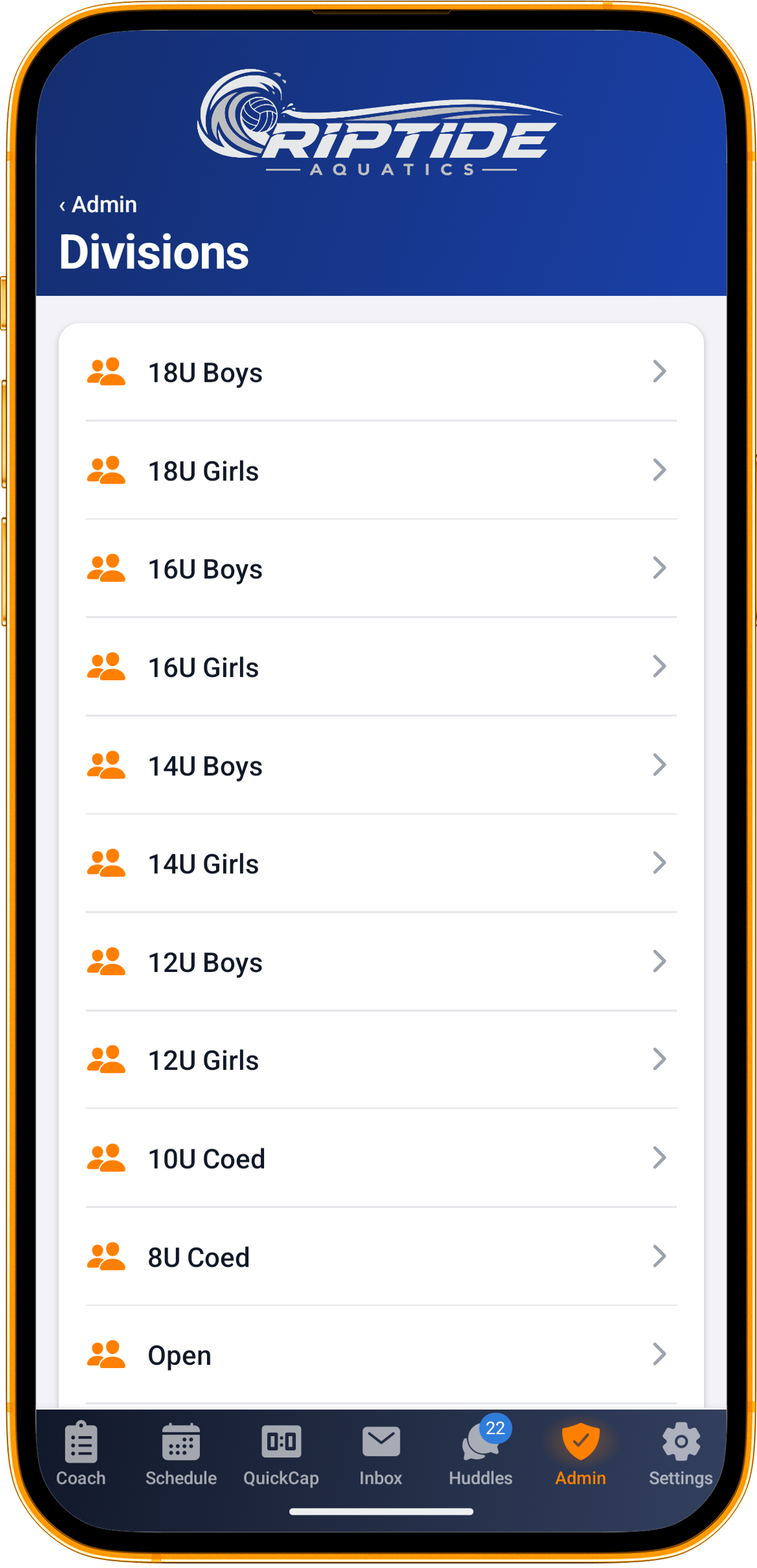
Clubs running age groups from under-7s to under-19s need structure rather than one long alphabetical list, so divisions, teams and cohorts organize the club. Athletes sit in a cohort by the year they graduate, and cohorts are placed into divisions per season, which means next August the whole age group moves up together instead of being re-entered one child at a time.
One parent, one login, every child
Families are real records rather than a column on a player. One parent account covers every child across every age group, and when a player moves teams mid-season their schedule, their availability requests and their team’s Huddle move with them. That single decision is usually what determines whether parents use club software at all.
One soccer Huddle,
not eleven group texts.
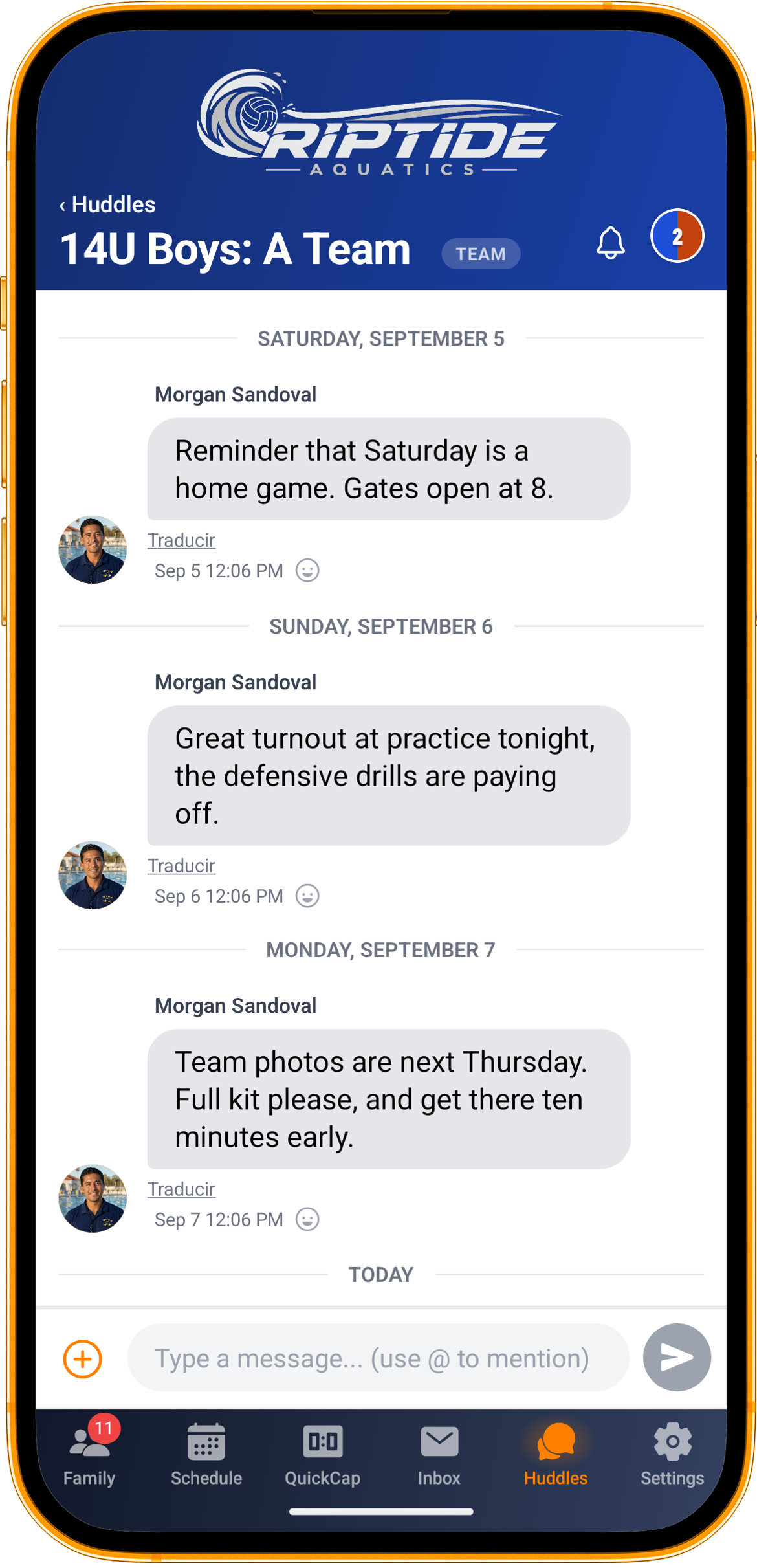
Team and division Huddles created with the team, with role mentions and on-request translation.
The Huddle already exists
Huddles are created with the team and their membership follows the roster, so a player who joins in October joins the conversation and can see what was said in September. Mention @coaches or @guardians and Rostered resolves it to the people holding that role in that Huddle right now, rather than a list of names that went stale the moment the squad changed.
Reactions, attachments, announcement mode
Reactions absorb the acknowledgments, so forty parents can confirm they have read the new kickoff time without generating forty notifications for everybody else. Attachments keep the field map and the tournament schedule with the message. A Huddle can be set to announcement mode when the club needs something read rather than discussed.
Clubs that are not monolingual
Youth soccer in the United States is frequently not a monolingual sport. A Huddle message can be translated on request with the original kept alongside it, and if the message is later edited the translation is refreshed rather than quietly describing the previous version. A club with Spanish-speaking families runs one conversation rather than two that drift apart.
What soccer clubs get
- Positions
- Goalkeeper, Defender, Midfielder, Forward
- Youth ages
- 6 to 19
- Governing bodies
- U.S. Soccer Federation, US Youth Soccer
- Also included
- Polls, volunteer jobs, release forms, in-app club email, translation, locations with the forecast.
- Cost to families
- Free, always. No ads.