More than one team,
and not one long list.
A club with four teams in it is not a bigger team. It is four schedules, four rosters, four sets of families who each need to see their own, and one person who has to see all of them at once. A division is how Rostered keeps those two views from fighting.
How it works
Group the club
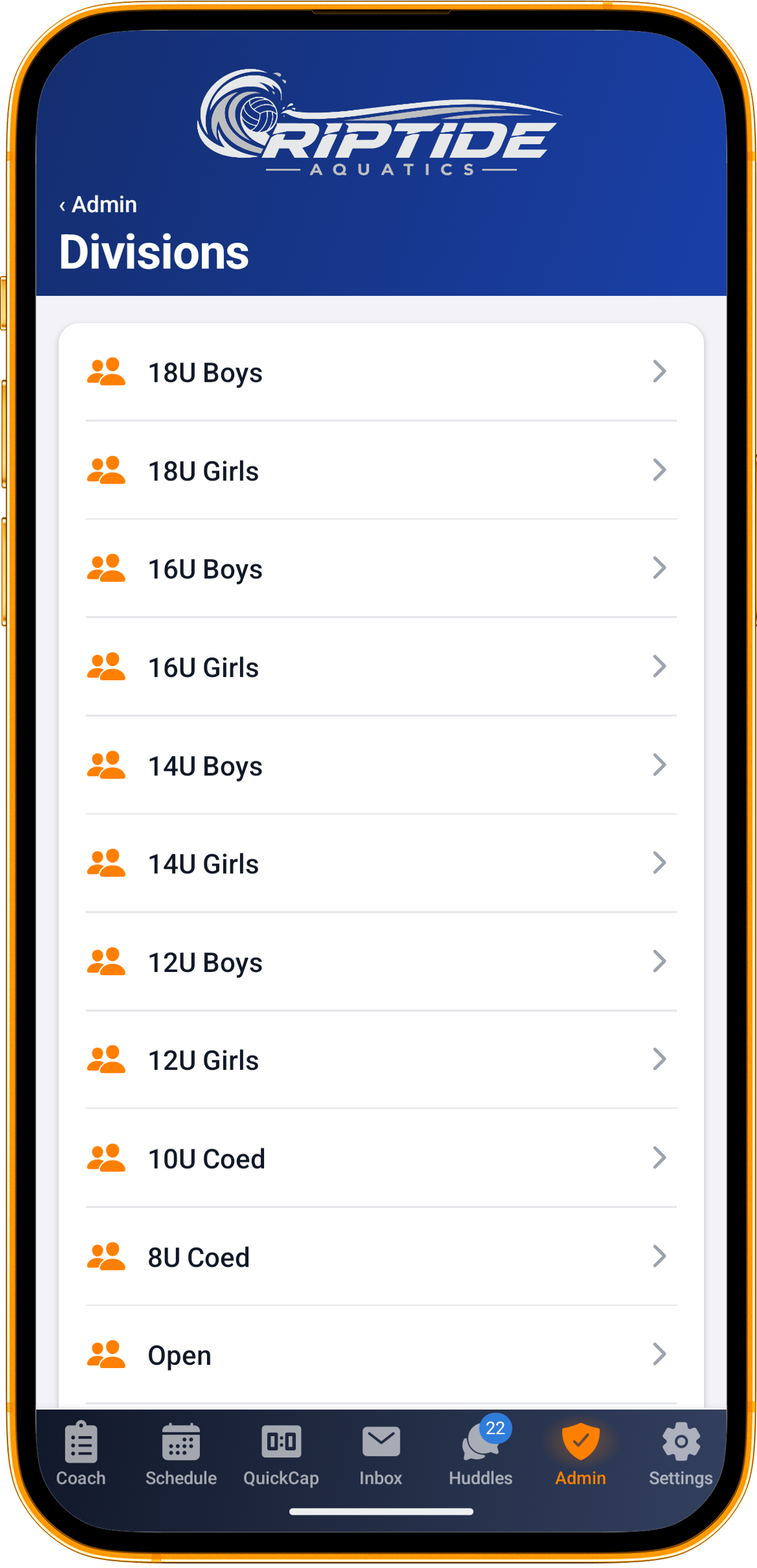
A division is the level between the club and a team: an age group, a gender, a program. Most clubs already have them and call them something; this is where the name goes.
Put the teams in it
A division holds teams, and a team holds athletes. A club running 12U Boys A and B puts both in the 12U Boys division and stops explaining the difference to anybody.
Attach the season to it
Events target divisions, so a session can belong to every team in 14U without being published at the whole club. Families see their own week rather than everybody’s.
Let it carry its own traffic
Each division has its own calendar feed and its own message channel, so the people in it hear what concerns them and nothing else.
A schedule that knows who it is for
Events attach to divisions rather than being announced at the club, so a 10U parent is not reading about a 16U tournament. That is the whole difference between a calendar families trust and one they stop opening, and it is the first thing that breaks when a club outgrows a single list.
A calendar feed per division
A division has its own subscribable calendar, alongside the club, team, athlete and family feeds. A coordinator responsible for one age group can subscribe to exactly that, and a family can take the feed that covers their child rather than filtering a club-wide one in their own head.
A channel per division
Each division carries its own message channel, created with it. A message to 14U reaches 14U, which means the coordinator who has something to say to forty families can say it without starting a thread that reaches four hundred.
Cohorts, for the group that moves together
A division is where your athletes are this season. A cohort is the group that moves up together, which is what makes season rollover possible without re-entering anybody. The two are different jobs and a club big enough to need divisions is usually big enough to need both.
And one person who can still see everything
The point of structure is not to hide things from the people who run the club. An administrator sees the whole club across its divisions; a coordinator sees the division they are responsible for; a family sees their own athletes. Three different right answers to the same question, which a single undifferentiated list cannot give.
What’s included
- Divisions between the club and its teams, named by you
- Events targeted at a division rather than the whole club
- A subscribable calendar feed for each division
- A message channel created with each division
- Cohorts for the group that moves up together
- Club-wide, division and family views of the same season
Questions
Do we need divisions if we only run one team?
No, and a single-team club is a shape Rostered expects rather than a club doing it wrong. Divisions start earning their keep the moment there are two teams whose families should not be reading about each other.
How many divisions can we have?
Each package carries a number of divisions. Squad and Team hold one, which is the right shape for a club running a single team, and the larger packages hold more. If you need another division mid-season, move up to the next package: the change is quick, and you only pay the prorated difference for the rest of the month.
Are divisions and teams different things?
Yes. A team is the group that plays together; a division is the level above it that holds one or more teams. A club with one team per age group still has divisions, they just each contain a single team.
What happens at the end of a season?
Season rollover proposes next season’s divisions from the ones you have, and cohorts carry the athletes who move up together, so a club is editing a proposal rather than rebuilding its structure every year.