Show Families Exactly What Paperwork Is Left
A release, a swim-test question and a jersey size should not all sound equally urgent. Rostered puts what a club still needs into one checklist per family, marks what actually blocks participation, and keeps every answer correctable.
“You still need to do your forms” is not an instruction. It is the beginning of a conversation that will take four messages and end with somebody screenshotting a screen.
Which athlete. Which club, if you have kids in two. Which form. Whether it is the thing stopping your daughter getting in the water on Saturday, or a question about jersey sizes that somebody will ask again in April either way.
The club knows all of that. The parent, opening the app on a Tuesday night, usually does not.
Two stacks that meet in one place
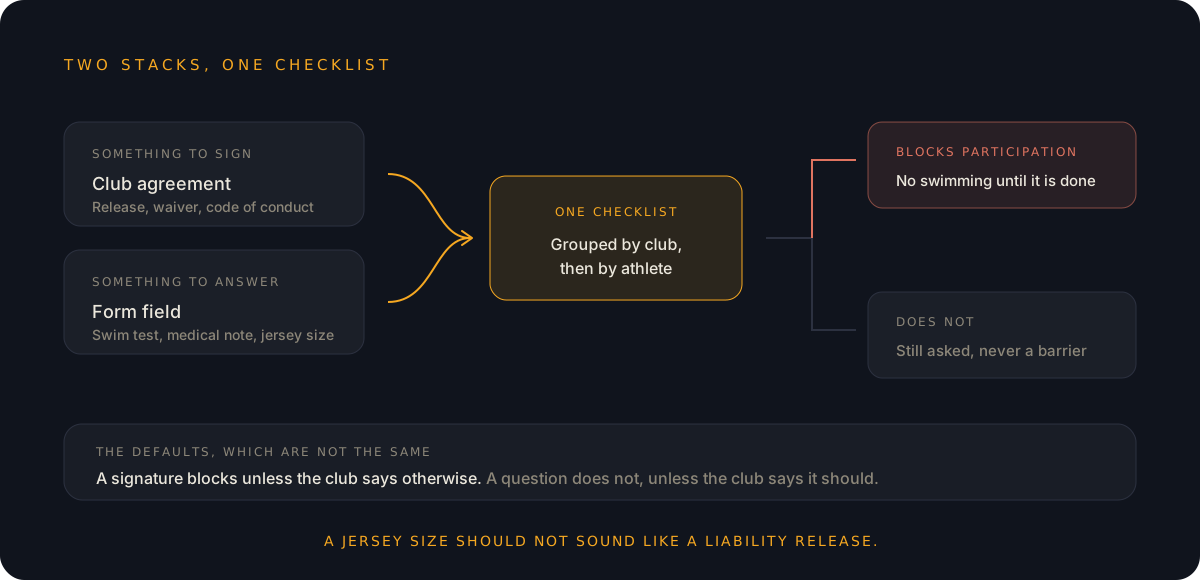
A season’s requirements come from two different systems. Things to sign, which are club agreements: the release, the waiver, the code of conduct. And things to answer, which are form fields: the swim test, the medical note, the jersey size.
Those are separate stacks in almost every club management tool, and they surface separately, which is how a parent ends up with two kinds of outstanding work in two places and no sense of which matters.
In Rostered a season requirement can be either one, and both land on the same checklist. It is grouped by club first, because a family with children in two organizations is answering to two sets of rules, and then by athlete, because a release belongs to the child it names.
The distinction that makes the list usable
Every requirement is either something that stops an athlete taking part until it is done, or something the club wants but will not bench anyone over.
That single flag is what turns a list of tasks into a list you can triage. Without it, the release and the jersey size look identical, and a parent with fifteen minutes has no way to spend them well.
The defaults are deliberately different, and they are the right way round. A club agreement blocks participation unless the club says otherwise, because the reason a club asks for a signature is usually that somebody should not be in the water without it. A form field does not block unless the club marks it so, because most questions are logistics.
A club can override either. The point is that the safe assumption for a signature and the safe assumption for a question are not the same assumption.
”Not now” is a snooze, not an answer
The prompt that tells a family they have outstanding work can be dismissed. That dismissal is a snooze rather than a decision, and it is spent when any of three things happens: the club asks for something new, a day passes, or the guardian signs in again.
That third one matters more than it looks. A dismissal that only the club could clear would leave a parent who tapped “not now” by accident with no way to bring the prompt back themselves. Signing in clears it, so a mis-tap costs you a session rather than a season.
It is a small thing and it is the difference between a prompt that respects a parent and one that punishes a slip.
The mid-season join is the one that usually gets missed
The athlete who turns up in week six is where registration quietly fails, because everybody assumes the opening-week process already caught them.
Rostered does not solve this with a hook on each way an athlete can arrive. It solves it with a sweep: when a season opens, and again after a mid-season create or reactivation, a job walks the club’s active roster and opens a registration for anyone who does not have one.
The difference matters. A per-doorway hook has to be added to every doorway, and the one somebody forgets is the one that quietly stops asking families for paperwork. A sweep over the roster does not know which doorway an athlete came through and does not need to. Admin created them, a family setup did, an import did, a signup approval did, they were reactivated after a year away: the sweep sees an active athlete without a registration and opens one.
What a family said is still there
When a family answers a question about their athlete, that answer stays visible to them afterwards, and they can correct it.
Corrections do not overwrite. Each one adds a numbered revision, and revisions cannot be edited or deleted once written, by the family or by the club. So the current answer is whatever was said most recently, and the record of what was said before it survives.
That is the quiet half of the trust here. A parent who tells a club something important should be able to find what they said. A club that acted on an answer in August should be able to see the answer it acted on, not just the version that replaced it in October.
What this does not do
It does not decide what your club should ask for, or what should block participation. Those are the club’s calls and they should be, because they are judgment about children rather than configuration.
It does not chase anyone on your behalf either. It makes the outstanding work visible, specific and finishable, which removes the reason most of the chasing existed.
If you are bringing a roster in from a spreadsheet, the importer is the step before this one, and it holds every invitation until you are ready to send them.
Rostered is free for every parent and athlete, and clubs start at $9 a month. See what’s free, look at the packages, or start your club.