High School Rosters Run on Class Years, Not Age Bands
A 14 to 18 age band spans five birth years. A high school holds four classes. Getting that wrong gives a club an extra cohort of athletes who are still in middle school, and it is why Rostered builds high school programs by level instead.
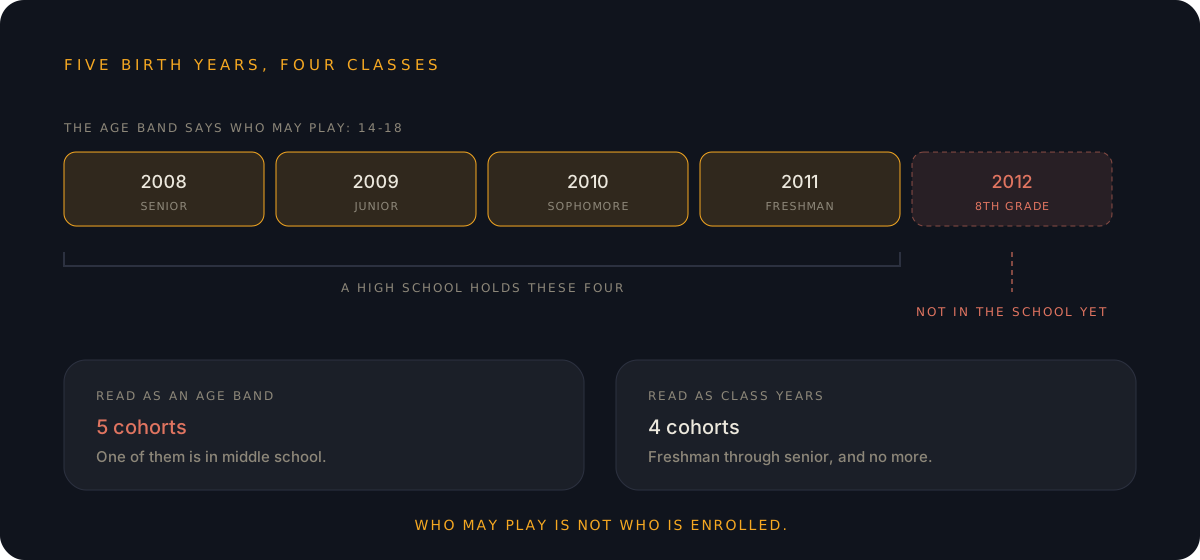
Most youth sports software is built on age bands. 12U, 14U, 16U. It is a good model, it matches how club sport actually organizes itself, and it breaks the moment you point it at a high school.
The reason is a one-word difference that turns into a real roster problem: an age band names who may play. A class year names who is enrolled. Those are not the same set of people, and they do not even produce the same number of groups.
Five birth years, four classes
Take a high school program with a 14 to 18 age band. That band covers five birth years.
A high school holds four classes.
The extra year is not a rounding error with a name attached. It is next year’s freshmen, who this season are in eighth grade and not at the school at all.
That is the trap in running a high school program on age-band software. The band is correct about eligibility and wrong about enrollment, and a club set up from it carries a fifth graduating class nobody wants.
Rostered builds a high school club from the school year instead: four graduating classes, matching the four years a student is actually there.
Varsity and JV are not age groups
The same distinction shows up one level down.
Varsity, JV and Frosh are competitive levels. A club does not put athletes in them by birthday, it puts them there by selection, and two of them can hold a fifteen-year-old at the same time. Age bands never collide like that. 14U and 16U are mutually exclusive by construction; Varsity and JV are not.
So Rostered builds a high school program as one division per level rather than one division per age group. When a club is set up as a high school, it gets Varsity, JV and Frosh, and it picks how the program is split:
- Boys, one set of levels.
- Girls, the same.
- Both, a full set of levels for each, side by side under one club.
- Coed, where the levels carry no gender at all. The division is just Varsity, which is also the right answer for a program that is not a sport in the usual sense.
You can change it later. Schools add programs, drop them, and reorganize, and the shape a club picked in its first week should not be the shape it is stuck with.
What the roster should call a fifteen-year-old on varsity
Here is where the age-band model produces its most annoying output.
A sophomore selected for varsity is not there because of their birthday. They were picked. But software that thinks in age bands can only describe them one way: as playing up, out of their group, an exception to a rule that was never the rule here.
On a level-based high school roster, Rostered shows class standing instead. Freshman, sophomore, junior, senior. That is what the coach said, what the family says, and what the athletic office has on file.
It only does this where the label is honest. The standing comes from the distance between the athlete’s graduating year and the season’s, and outside the four years of school there is nothing true to say. A fifth-year, or a cohort someone set wrong, gets no label rather than a confidently wrong one. Silence beats calling somebody a freshman because the arithmetic ran off the end.
Why a club should care about any of this
None of it is glamorous. It is the difference between a roster an athletic director recognizes and one they have to translate.
A club that starts with the wrong shape does not usually notice on day one. It notices in the second month, when someone is maintaining a naming convention to work around the divisions, or explaining in every message which “JV” is meant, or quietly ignoring a cohort nobody can delete because they are not sure what it is for.
Getting the shape right at setup means the roster is a thing everyone can read, rather than a thing one person knows how to interpret.
If your program’s roster currently lives in a spreadsheet from the athletic office, that file is a fine place to start from: see how the importer handles it, including what it does with graduating year.
Rostered is free for every parent and athlete, and clubs start at $9 a month. See what’s free, look at the packages, or start your club.