Attendance Tracking Where Absent Is Not One Thing
A kid who was off school sick and a kid who vanished without a word are not the same absence. Rostered records the difference, keeps excused absences out of the attendance rate, and makes a coach say which reason it was.
Two athletes miss Tuesday. One was off school with a temperature and their mom messaged at lunchtime. One simply did not turn up and nobody has heard from them since.
Most attendance tools record both as the same word. Absent. Maybe there is a note somewhere. Maybe the coach remembers. Two weeks later one of those athletes has a worse attendance rate than they have earned, and the only person who could explain why is the coach who was not the one running the report.
A record that flattens those two into one word is not a neutral record. It is a slightly wrong one that gets more wrong every week.
A note on availability: attendance is a feature a club turns on. It is not on for every club by default, so if you want it from day one, ask. RSVPs, which are a different thing, work for everyone.
You cannot excuse an absence vaguely
A coach can mark an absence excused. What they cannot do is mark it excused without saying why.
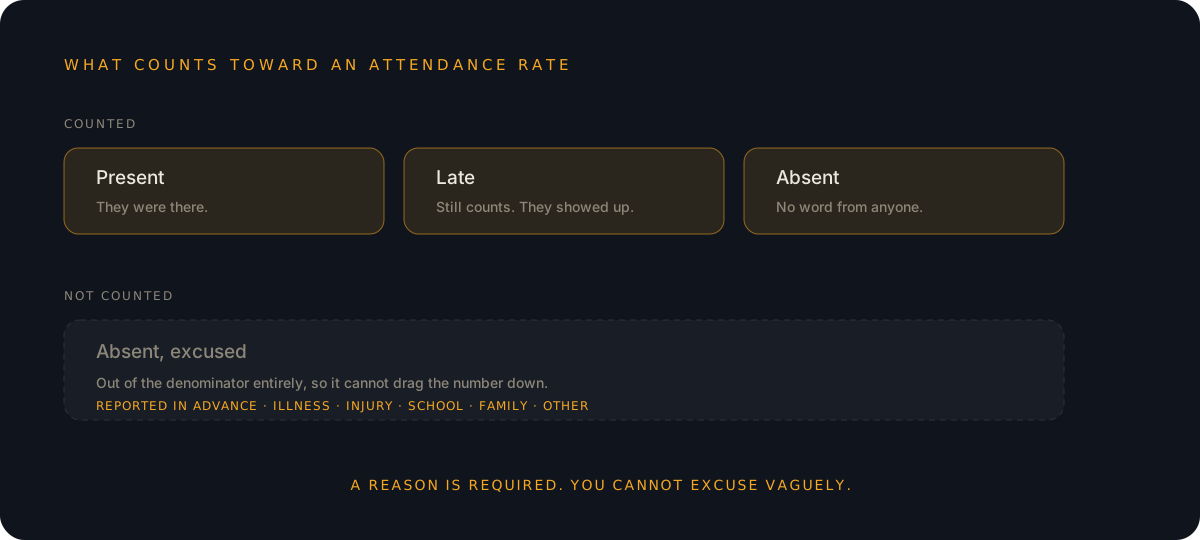
The reason is required, and it comes from a fixed list rather than a free-text box: reported in advance, illness, injury, school, family, or other. Six options, one of which is honest about being a catch-all.
That constraint is doing real work. A free-text field would fill up with “ok”, “fine” and blanks within a season, and the record would be no better than the flattened version it replaced. A required choice from a short list means that a year later, somebody who was not there can still read what happened.
What an excused absence does to the number
Here is the part that matters to an athlete.
An excused absence is removed from the attendance-rate denominator entirely. Not weighted, not softened, not marked with an asterisk somebody has to notice. It is simply not part of the sum.
So an athlete who came to eight sessions, missed one with flu and one because of an exam has an attendance rate of eight out of eight, and the two absences are still on the record with their reasons attached. The fact survives. The penalty does not.
Late arrivals count as attended, because they attended. That sounds obvious until you consider how many systems treat lateness as a partial absence. The athlete got there. Whatever conversation their lateness deserves, it is not one about commitment to showing up.
Late is something a coach says, not something the app infers
Rostered does not decide who was late from a timestamp.
A timestamp knows when somebody tapped a button. It does not know whether the athlete was late, the coach was late marking the register, or the whole session started ten minutes behind because the previous group overran. Inferring “late” from any of that is a system inventing a fact about a child.
So late is a deliberate mark, made by the coach, and it can be taken off again. On a phone, on a pool deck, with a roster of thirty and a session about to start, a thumb lands in the wrong place. A control you can toggle back is not a nicety there. The alternative is a permanent attendance fact created by a mis-tap.
Lateness only applies to an athlete who is present, which keeps the record from holding a contradiction: nobody is recorded as both absent and late.
The guardian’s answer and the coach’s mark are two different records
This is the part the feature is quietly cleverest about.
When a guardian checks their athlete in, that is stored separately from what the coach marks. They are not the same claim. One is what the family said; the other is what the person on the deck observed.
Keeping them apart means the two can be compared, and there are exactly two ways they disagree. A guardian said not today and the coach marked present. A guardian said here and the coach marked absent.
Both are worth a look, and neither is automatically anybody’s mistake. A kid changes their mind and turns up. A kid gets dropped off and never makes it to the right pool. The useful thing is that the system notices the disagreement rather than silently overwriting one answer with the other, which is what a single shared field would have done.
This is context, not a disciplinary system
It is tempting to turn attendance into a scoreboard, and we are deliberately not doing that.
Rostered does not decide eligibility, playing time, or who makes the squad. It does not flag an athlete for a coach’s attention or score anyone’s commitment. It keeps a record with enough context to support a conversation, and then it stops.
The excuse reason is for staff. A family does not need a coach’s internal categorization of their week reflected back at them, and a record that a coach would hesitate to write honestly is worth less than no record at all.
Why the detail is the point
A coach already holds all of this in their head. They know who was sick, who has exams, who is having a hard term, and who has quietly stopped showing up.
What they do not have is a way to put it down that survives them being busy, or being away, or handing the group to someone else in March. That is the job here. Not to replace what the coach knows, but to make it possible to write it down at the speed they actually work.
Rostered is free for every parent and athlete, and clubs start at $9 a month. See what’s free, look at the packages, or start your club.