Club Emails in Spanish, Without a Second Thread
Rostered clubs can write one campaign and send every family the version they read, in English or Spanish, with the send blocked if a translation falls behind the original.
Here is the problem that makes bilingual club communication harder than it looks.
To send a family the language they read, you have to know which language they read. To find that out, you have to ask them. And you have to ask them in a language they can read.
You cannot ask a family their language in a language they cannot read. Every club that has tried to do this properly hits that wall, usually about four minutes in, and most of them solve it with a person: a bilingual parent who translates the important ones, forwards them separately, and quietly becomes a single point of failure for half the club’s communication.
What a club can turn on
A Rostered club can support more than one language. Today that means English and Spanish (United States), which is a real answer rather than a big one, and it is worth saying plainly rather than implying a list that does not exist.
It is off until a club turns it on. A club that never touches the setting sends and receives exactly as it did before, and sees no change anywhere.
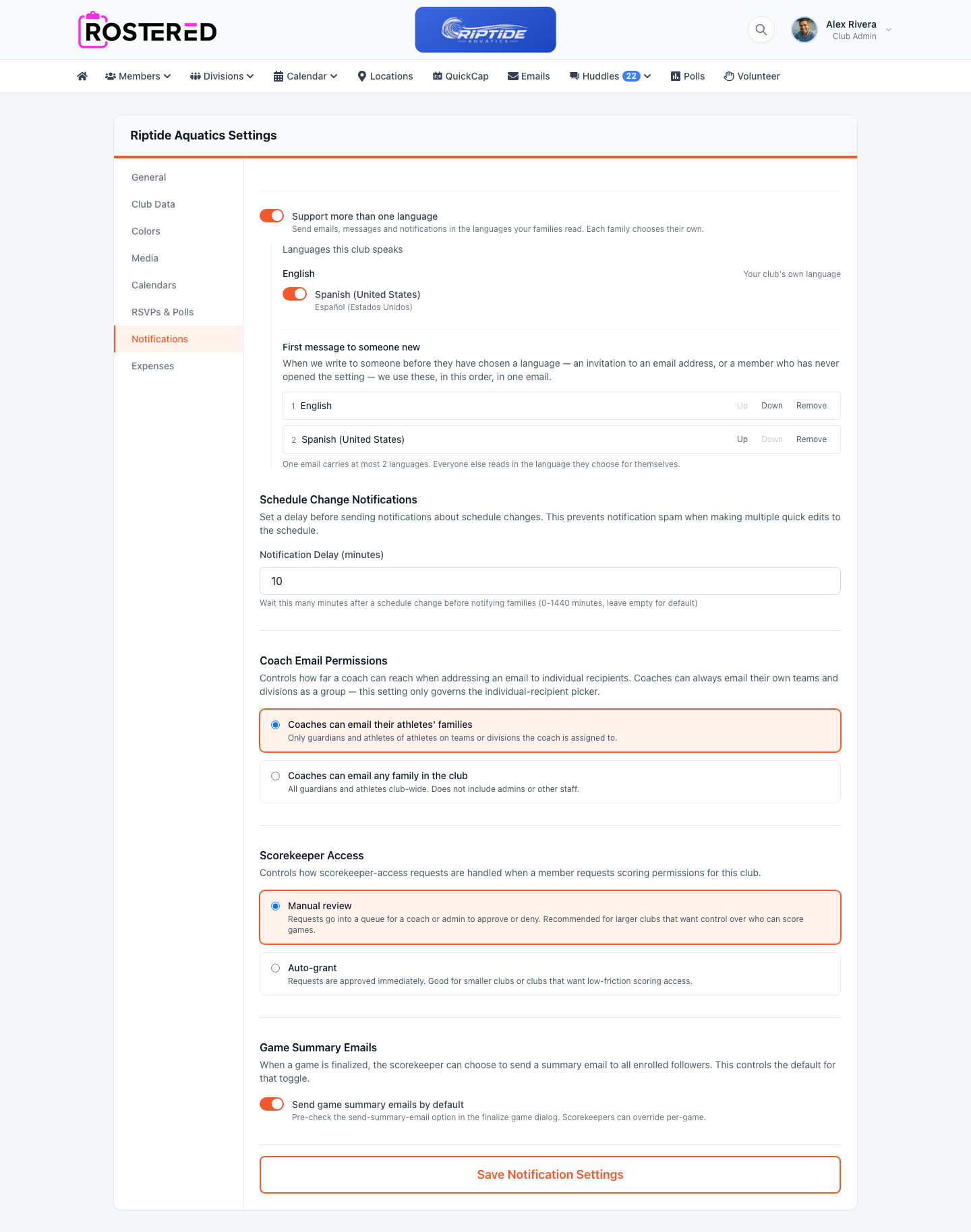
Once it is on, the club names the languages it speaks. English is always one of them.
The first message solves the asking problem
That second block in the screenshot is the answer to the wall.
When Rostered writes to someone before they have chosen a language, an invitation sent to an email address, or a member who has never opened the setting, it uses the club’s first-message languages in order, in one email. Both versions, one message, the club’s preferred language first.
One email carries at most two languages. That is a decision rather than a technical ceiling: two languages in one invitation reads fine, and four is a wall of text where the half that matters is below the fold.
After that, everyone reads in the language they chose for themselves.
One campaign, not two
When an admin writes a club email, the languages live inside the same campaign rather than in a second draft somewhere else.
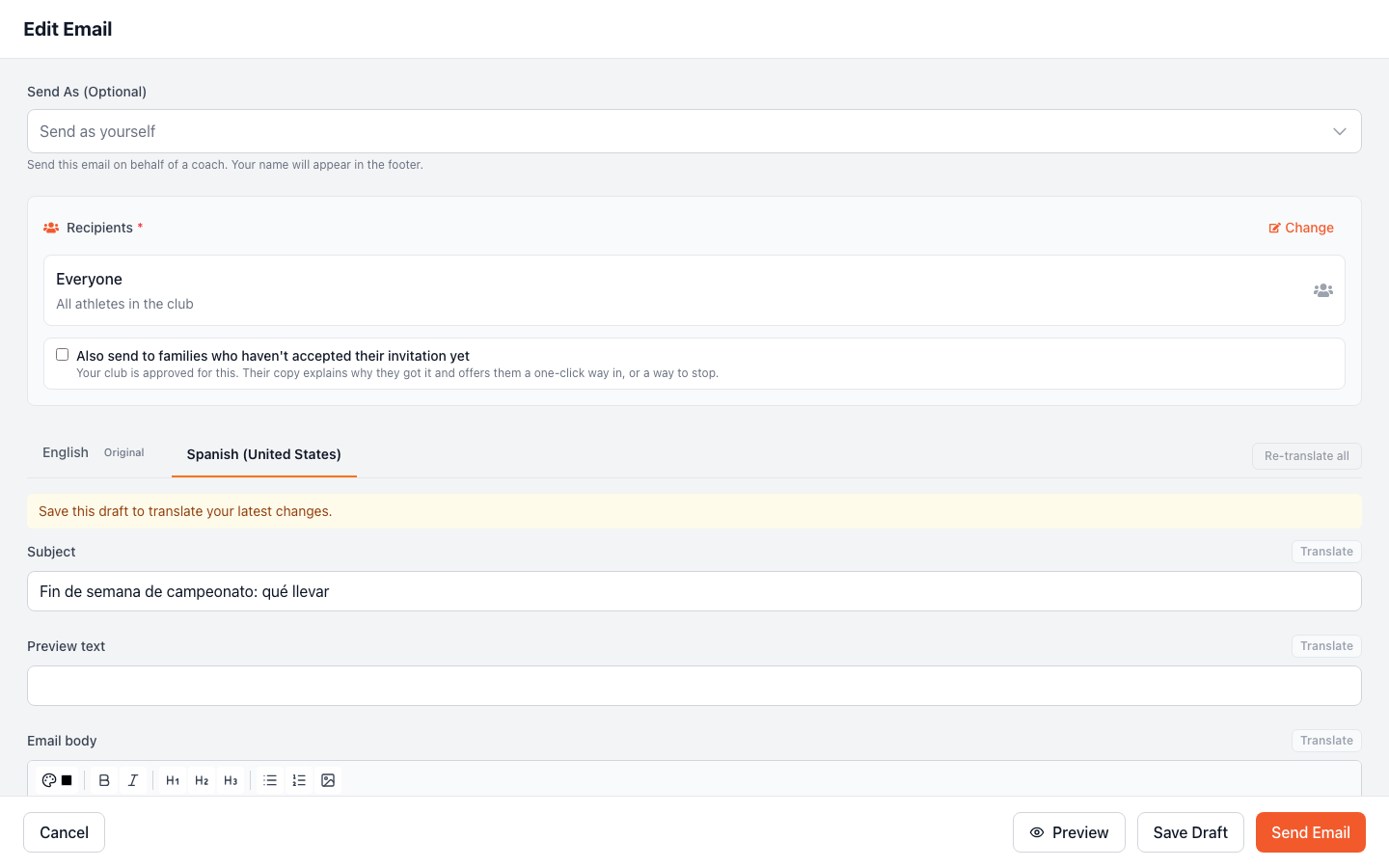
The composer puts the original and each other language on tabs. Subject, preview text and body are held separately for each one, so the Spanish version is a real piece of writing rather than the English with a note attached.
The part that stops the bad send
This is the piece that matters most, and it is the least visible.
Every translated version records a fingerprint of the English it was made from. Before a campaign goes out, Rostered compares that fingerprint with the English as it stands now. If somebody edited the original after the Spanish was written, the Spanish is out of date, and the send is refused with the language named: the Spanish version is older than the English, re-translate it before sending.
It is worth explaining why it works that way. The obvious implementation is a flag that gets flipped whenever someone edits the campaign. The trouble with a flag is that every editing path has to remember to flip it, and the path somebody forgets is the one that sends three hundred families an arrival time the English no longer says. Comparing fingerprints at send time cannot be forgotten, because nothing has to remember anything.
The failure this prevents is the specific one that makes families stop trusting translated messages: two versions of the same email with two different details, and no way to tell which one is current.
Machine drafts say they are machine drafts
Rostered can draft a translation for you. When it does, that is recorded as machine-drafted, and what it produced is kept beside whatever actually went out.
If a human rewrites it, the human wording is not relabelled as machine copy, and the pair is kept: what we generated, and what a person decided to send instead. A club can see where the drafting is good enough to trust and where it is not, on its own messages rather than on a vendor’s claim.
What each family gets
Each person has their own communication language, so a household is not a single setting and a club does not have to maintain a list.
Three things all have to be true before anyone receives anything other than the English a campaign was written in: the club sends in that language, the reader has asked for translated messages, and somebody actually wrote that language for that particular campaign. Miss any one of them and the email arrives in the original. A version that has fallen behind the English counts as missing, which is the same rule as the one that blocks the send.
That is why a family can have two emails from the same club sitting side by side, one in each language.
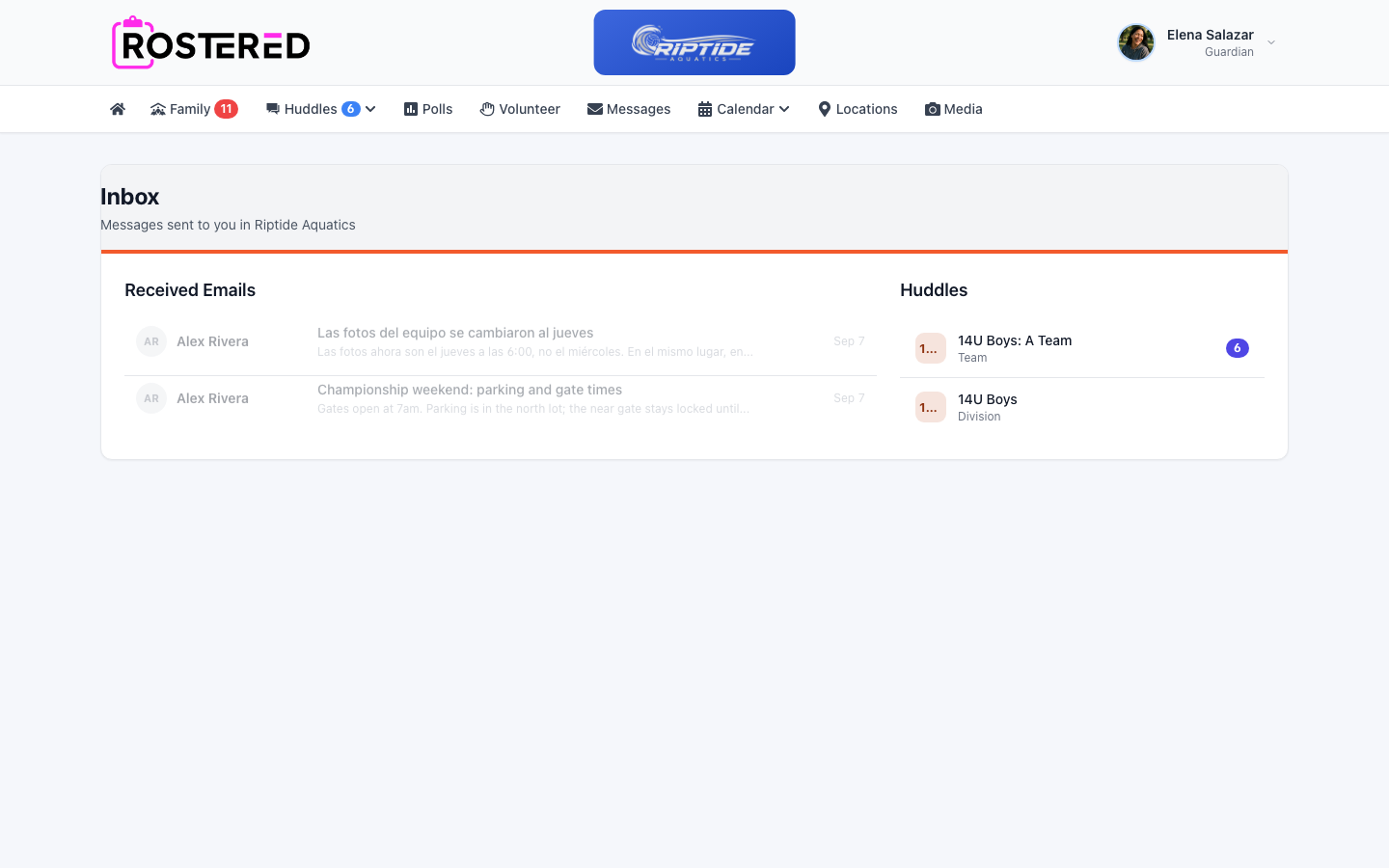
Families who want both languages can have both in one message. The email arrives with their language first and the original underneath, which is the version people tend to want when the message is about money or a deadline and they would rather check the original wording themselves.
Two limits worth stating
This is communications, not the interface. The app itself is in English. What changes language is what the club sends: emails, the copy that lands in the family’s inbox in the app, and notifications. There is a separate setting for the app’s own language and nothing reads it yet, so we are not going to describe the app as bilingual when it is not.
It is per club, and it is off by default. Nobody is opted in. A club that wants it turns it on, names its languages, and picks the first-message order.
Neither of those is a caveat we are burying. A club with Spanish-speaking families should know exactly what it is getting before it tells those families anything.
Why this is worth doing properly
Most clubs already have a workaround, and the workaround is usually a generous person. Generous and fragile are not opposites. That parent has to notice every change, update every copy, and send every version to the right people, and the season they burn out or move away is the season half your families stop hearing from you.
Putting the languages inside the campaign means the club has one place to check before a message goes out, and one record afterwards of what each family was actually told.
Rostered is free for every parent and athlete, and clubs start at $9 a month. See what’s free, look at the packages, or start your club.